Supporting Local Solutions in West Africa: A Lasting Legacy Brings Clean Water to Local Communities
Robert Coffey knows all about digging wells. As a Peace Corps volunteer in the late 1960s, he was part of a team that worked in the West African country of Burkina Faso to construct wells that, because they kept out contaminated water, had an immediate impact on the health of local communities. Today, he advances this work by supporting Association Omigbefite, a local organization working to improve access to clean water in Burkina Faso. And through his newly established Burkina Faso Development Legacy Fund at Myriad USA, he will be able to support this work for years to come.
Download PDF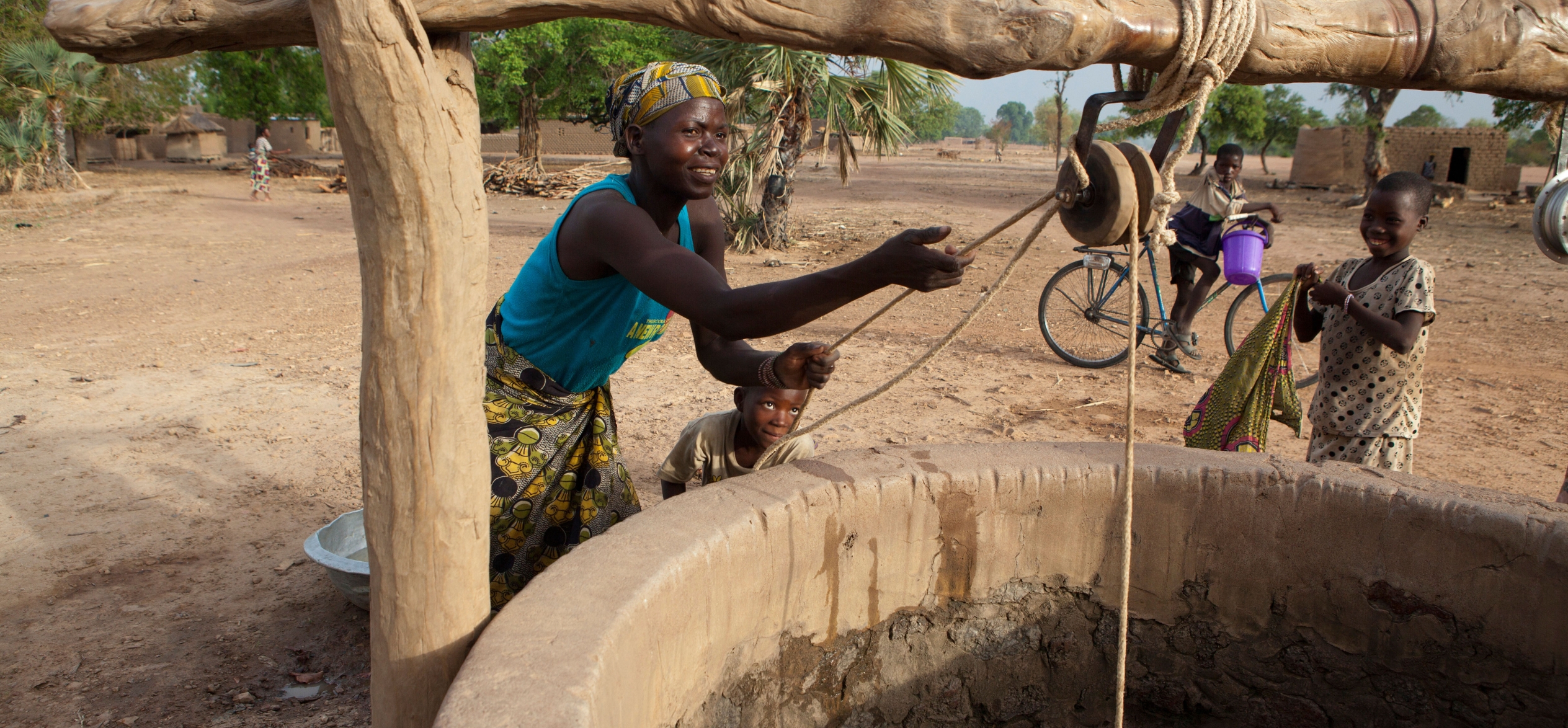
While American donors are among the world’s most generous, West and Francophone Africa receive little visibility and funding. When donors fund organizations in this region, they tend to direct their gifts to international NGOs. This is partly due to limited media coverage and language and cultural barriers that make it harder for American donors to engage.
For Robert Coffey, his time in Burkina Faso not only introduced him to the complex and structural challenges the country faces. It also informed his philanthropic journey upon returning to the U.S.—partly through the friendships and connections he established while there and more recently with the help of Myriad USA. As he has found, working with the right partners to create meaningful impact in communities in this part of the world—while moving away from traditional aid language and models—is deeply rewarding. “I can have a big impact on lots of people who need clean water,” he says. “It’s a relatively inexpensive intervention with a big bang for your buck.”
A Peace Corp Volunteer’s Enduring Connection to Burkina Faso
As a Peace Corps volunteer, Robert Coffey’s first trip to Burkina Faso left a lasting impression on him. He was struck by the stark simplicity and hardship of life for the traditional communities where he was working on well construction. However, he was also impressed by the honest, upbeat character of the people he encountered—something reflected in the name Burkina Faso, which was chosen as the country’s post-colonial name to reflect the pride of the nation, as it translates to “Land of Honest People.”
Coffey’s encounter with the country during his time as a volunteer was the start of a lasting relationship with Burkina Faso and its people. “It’s a wonderful place,” he says. “I enjoyed it immensely and I felt like we were doing some important work in producing clean, potable water.”
He also gained a first-hand view of what happens to communities when they lack access to clean water. “If the women in the village are spending six hours walking to get water, they’re not doing the other things they need to do,” he says.
Lack of access to clean water also exposes people to waterborne diseases such as diarrhea, dysentery, and cholera, which for children increases the risk of death. Moreover, in the absence of properly designed wells, malaria can spread since stagnant water creates breeding grounds for mosquitoes.
In helping protect communities from these risks by building wells, Coffey came to understand the powerful benefits of this work. “The biggest effect of providing potable water to communities is the health effects,” he says. “It’s dramatic and it’s immediate.”
The Start of a Productive Relationship
In 2006, Coffey brought his wife and children to Burkina Faso to experience the country that had left such a lasting impression on him. The people they met included a woman running a cotton growers’ cooperative in the northwest region, a man in northern central Burkina who was building middle schools for girls, and his wife, a nurse practitioner and midwife who was running a reproductive health clinic. It also led to recognizing an important challenge: figuring out how to support these critical community projects through international philanthropy once they returned to the U.S.
They also stopped in the town of Loropéni in the southwestern province of Gaoua. There they met a man, Togo Pale, who Coffey describes as an “animateur”—an energetic, entrepreneurial citizen of Loropéni who through his organization, Omigbefite, was organizing everything from support for orphaned children to local projects generating income and improving quality of life for communities by educating gardeners, welders, seamstresses, health educators and others.
The first thing that happens when a well is producing clean, potable water is that abdominal pain and diarrhea vanish. That’s a wonderful outcome.
Coffey’s friendship with Togo and financial support for those projects eventually led to their collaboration to meet a truly dire local need: drilling and developing wells to ensure access to clean water.
Today, the two are in nearly daily contact. And the donations from Coffey and his wife—as well as from his friend and former Peace Corps colleague Charles Rodgers and his wife—have made a significant impact. “Since the spring of 2021, we’ve built about 24 wells, a couple of them solar powered and the rest hand-pumped,” he says.
He acknowledges the critical role Togo has played. “The key to this whole thing is Togo,” says Coffey. “Without Togo being the facilitator, hiring and working with the drilling companies, and getting the villagers involved to set up well maintenance teams, we wouldn’t be doing this.” This sentiment is consistent with Myriad USA’s belief that local context matters a great deal.
The Next Step on a Giving Journey
While Togo is Coffey’s on-the-ground contact for the well-building projects, three years ago he formed a partnership with Myriad USA and began working closely with Kady Sylla, Director – Africa and Middle East, to help maximize the impact of his contributions to the region.
“What we found over the years was that we didn’t have a way to give to foreign charities,” he explains. Working with Myriad USA, Coffey opened an American Friends Fund for Association Omigbefite, which enables his gifts to be tax-deductible under the U.S. tax code. “And Myriad USA has been very helpful in showing us how to structure our grant requests,” he explains.
This has been so rewarding for me—the opportunity to stay in communication with Burkina, a country and a people I adore, and, in my late retirement, to feel I’m still contributing somewhere in the world. That’s a big deal.
Also, Myriad USA has helped expand his network in Burkina Faso. “Kady has been instrumental in connecting me with others involved in well digging and drilling,” he explains. “Their team offers great opportunities to learn about other vetted projects in West Africa that are doing meaningful work for their communities and are likely to make good use of your dollars.”
Three years on from the start of his engagement with Myriad USA, Coffey began to look into ways in which he could make a more lasting gift to the communities of Burkina Faso. He decided to open a Legacy Fund that will continue to make gifts to Association Omigbefite for the coming ten to fifteen years. “When we designed the Legacy Fund, we specifically talked about how many years it could be practical,” he says, “Maybe Omigbefite lives longer than that, but maybe it then finds other sources of income.”
With a Legacy Fund, donors can create a charitable legacy for the communities they cherish, anywhere across the globe. A Legacy Fund will make gifts to a donor’s preferred charity or cause, in perpetuity or for a specific number of years. Contributions can be made during their lifetime or through a bequest or other planned gift, such as naming the fund as beneficiary of a retirement plan or life insurance policy.
For Coffey, that means continuing to help fund the construction of the lifesaving wells that bring clean, potable water to the communities he cares so much about. “The idea is that when I’m gone, there will be money for another 10-15 years to support these same efforts,” he says.