Statues Also Breathe: Rewriting Trauma into Stories of Resistance and Resilience for Nigeria‘s Stolen Girls
In April 2014, the world learned a number: 276 schoolgirls abducted. For many, that moment became fixed in history as a global tragedy. But for the girls themselves, that number became an identity. To be a ‘Chibok Girl’ meant being frozen in the global imagination as a perpetual victim.
Download PDF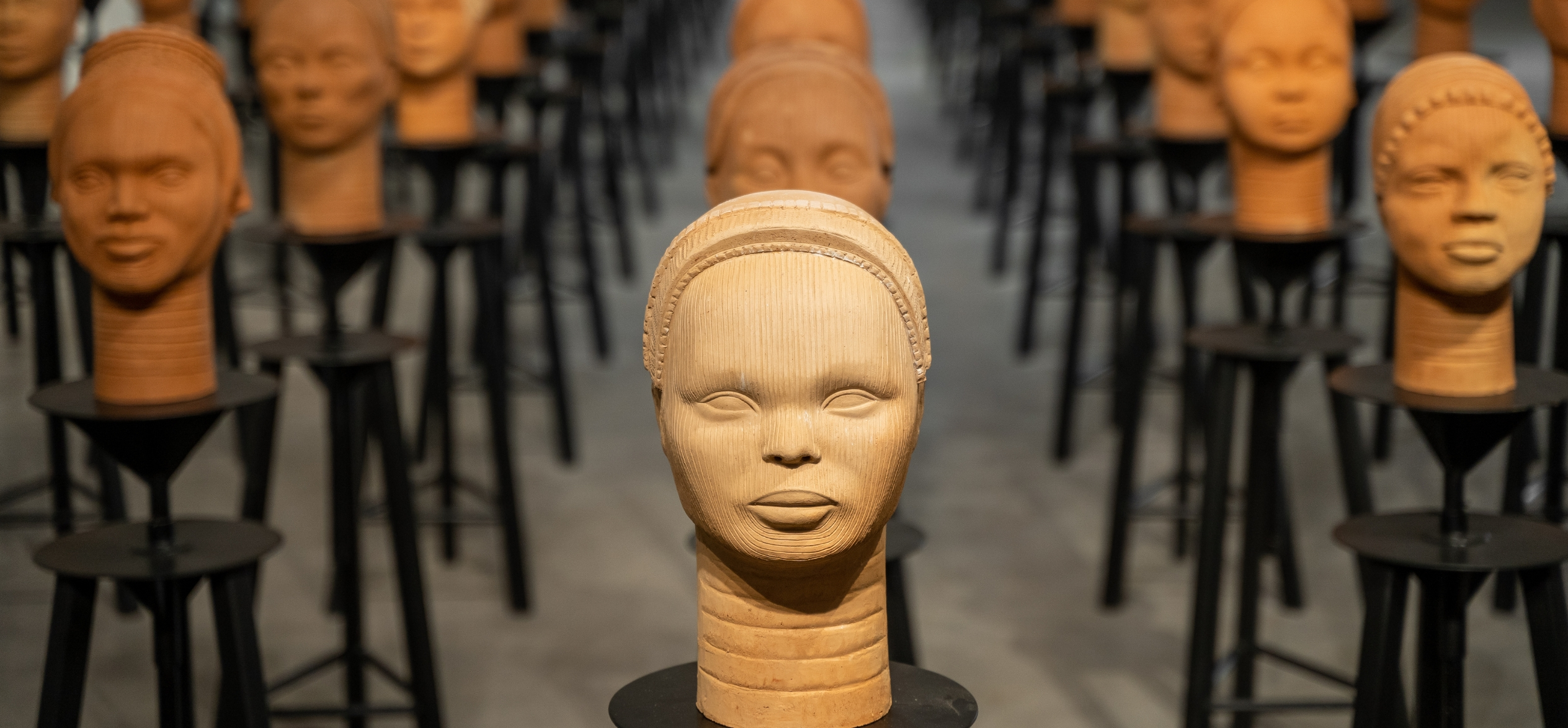
How can a site of trauma become a space for compassion, empowerment, and action? Statues Also Breathe confronts this question directly. Led by sculptor and Catharsis Arts Foundation co-founder Prune Nourry, the art project brings global visibility to the 108 still missing students across Nigeria and to the families of the 276 Chibok schoolgirls abducted by Boko Haram—an event that ignited the worldwide #BringBackOurGirls movement.
This year, it is leading the global tour of Statues Also Breathe. For Catharsis, this initiative is not simply an exhibition; it is the origin story of the organization’s mission to use art as a catalyst for healing, truth telling, and dignity. The exhibition opens to the public at the Museum of African Contemporary Art Al Maaden (MACAAL) in Marrakech on February 8, 2026, where it will remain on view for the entire year.
Catharsis Arts Foundation: A Commitment to Healing Through Art
Catharsis Arts Foundation was founded in 2023 by Nourry and Claude Grunitzky, an influential advocate for using art to confront trauma and expand collective awareness. As CEO of The Equity Alliance and Chairman of TRUE Africa, as well as a journalist and entrepreneur, Grunitzky has long championed the idea that art can rewrite narratives of pain into narratives of resilience.
From its inception, the foundation was envisioned as a collaborative, global platform centering the voices of women and girls. Its founding project and defining blueprint, Statues Also Breathe is rooted in traditional Yoruba crafts and mythology. The idea is that terracotta is a living material that holds the power to hold the soul, life, and would have been used by deities to create human life.
The use of clay anchors the project in deep cultural attitudes towards the sacredness of clay while highlighting the presence of the still-missing girls. They are of flesh, breath, and soul and are more than ‘represented’ by the army: the army tries indeed to ‘embody’ them, sharing their presence in a living way.
From Absence to Presence: The Making of the Chibok Portraits
The origin of the Statues Also Breathe project began in 2014 when Nourry was working on her first ‘army of girls’ in China, symbolizing the girls who were missing because of the one-child policy. When she learned about the kidnapping, Nourry began envisioning the power of art to support these missing girls.
With the help of a trusted colleague, Nourry was able to meet with the Chibok families and hear their story. She and Adé Bantu, the lead on the ground, were entrusted with portraits of the missing girls—deeply personal images that shaped the sculptures’ identities. Bantu, a prominent artist long engaged in activism, had been in close contact with the families since 2014.
Building the trust needed for such a collaboration required more than artistic vision; it meant forming an all‑Nigerian team and working closely with the Chibok Parents’ Association. Nourry began building this trust through a partnership with students from Obafemi Awolowo University and women potters from Ilorin, a Yoruba town in western Nigeria. The process took months of research and deep sharing.
In 2022, Nourry led a workshop that gathered 108 students, each crafting a single portrait based on a photo of a missing girl. Mothers, survivors, and relatives who escaped captivity joined them, guiding the sculptors and honoring their loved ones through shared memory and ritual. What emerged was an “army” of 108 heads—each distinct, each breathing presence into absence.
The parents had a positive reception of the project. They were also interested in the fact that the project tried to represent and embody them, as opposed to building a victimizing narrative crafted to suit the gaze of those outside of this context.
From Expanding Awareness and Deepening Action
Nourry’s dedication and persistence have raised the visibility of this project in a way that wouldn’t have been possible without her leadership. This contribution has not gone unnoticed.
The installation premiered at Art Twenty One in Lagos and has since traveled internationally. It stands not as a political statement, but as a human one—a call for remembrance, justice, and unrelenting hope. Nourry and Bantu seek to shine a light on the plight of the girls who are still missing and the complex reality of the survivors of the abduction; to celebrate the wealth and diversity of Nigerian culture; and to highlight ongoing threats to girls’ education globally.
In December 2024, the foundation began a two-year residency at Atelier Jolie, the creative collective founded by Angelina Jolie and located in the former studio of Jean-Michel Basquiat at 57 Great Jones Street, formally owned by Basquiat’s mentor and friend Andy Warhol. Monthly talks have gathered influential voices including Ekow Eshun, Enuma Okoro, Tschabalala Self, Lisane Basquiat, Jeanine Heriveaux, Christine Kuan, and Nourry herself.
A March 2025 New York Times article, “Angelina Jolie Wants to Pick Up Where Warhol and Basquiat Left Off,” highlighted Jolie’s vision to create a space for art and creative expression, as well as the role of Catharsis within it.
Beyond its core focus, Catharsis continues its long-term engagement with the Chibok families. Through its Field Coordinator program, the foundation works closely with five survivors—Rahab, Margaret, Jummai, Amina, and Mary—and an ally, Doris—supporting their leadership in sustaining attention on the girls still missing more than a decade later. The team also works closely with trusted allies such as board member Amy Gaman, whose long‑standing commitment underscores how essential a close, dedicated support network is to sustaining this work.
Catharsis provides educational grants and financial literacy training to help survivors finish university and build independence—both in Chibok and in Internally Displaced Person camps in Maiduguri. Its annual Remembrance Program ensures global attention does not fade, and these efforts were recognized with a nomination for the 2025 Women Have Wings Prize.
The Importance of Changing Narratives
Understanding the realities of the abducted Chibok women—and the many misconceptions surrounding their lives today—is essential to understanding the urgency behind Statues Also Breathe.
The first misconception is to call them the ‘Chibok Girls.’ They are no longer schoolgirls, but women. Another misconception is that they form a single, unified group. Little is known about those still captive, beyond rare videos released by the terrorist group, often showing them with children.
For those who escaped or were liberated, their circumstances vary widely. Some are pursuing higher education; others have completed vocational training. Several early escapees now live with relative independence—some married with children, some still with husbands they grew to care for despite forced marriage. Above all, each is redefining trauma in their lives and in the futures they are building.
We’re coming from a place where trauma is not consumed as content but held with dignity as we endeavor to make invisible people visible and continue to honor those who have been forgotten.
A Partnership Rooted in Shared Values
Catharsis Arts Foundation chose to partner with Myriad USA because of the deep alignment between the two organizations and Myriad USA’s ability to understand and support the foundation’s ambitions.
“The values and ethos of Myriad USA are truly in line with this and other of our projects,” Grunitzky said. “Both of our organizations are serious about Africa, women and girls, memory, strength, and cultural reclamation. And we are united in treating trauma not as content to be consumed, but as a human reality to be held with dignity.”
With an American Friends Fund hosted at Myriad USA, Catharsis can now better cultivate international support to amplify the story of the missing Chibok girls and the complex realities of survivors. As Grunitzky states, “It is an opportunity to reclaim African heritage as a living power—not frozen in the past, but resonant and alive.”
Prominent donor Virginie Chabran testifies, “These magnificent statues are a way to communicate and raise awareness so that we don’t forget those who are still being held captive. They also help those who have escaped from hell and need to heal their wounds.”
“As a woman and mother, this cause resonates deeply with me,” Chabran goes on to say. “What these young girls have experienced and continue to experience is a reminder that the fight for women’s well-being and living conditions around the world is still a pressing issue.”