Terracotta Warriors in Western Australia: Showcasing a Chinese Emperor’s 2,000-Year-Old Legacy
A once-in-a-lifetime exhibition, Terracotta Warriors: Legacy of the First Emperor, at the Western Australian Museum Boola Bardip, is fostering cultural exchange while honoring China’s cultural and scientific achievements. With the celebrated life-sized soldiers as its centerpiece, the exhibition also breaks new ground, since most of the more than 225 artifacts on show have never been seen in Australia. Some have never been on public display and others are newly unearthed and making their first trip outside China. More than 300,000 visitors have marveled at these objects—part of a hidden world from an ancient civilization that lay beneath the ground for 2,000 years. However, the exhibit has also made another mark by firmly placing the Western Australian Museum on the global cultural map.
Download PDF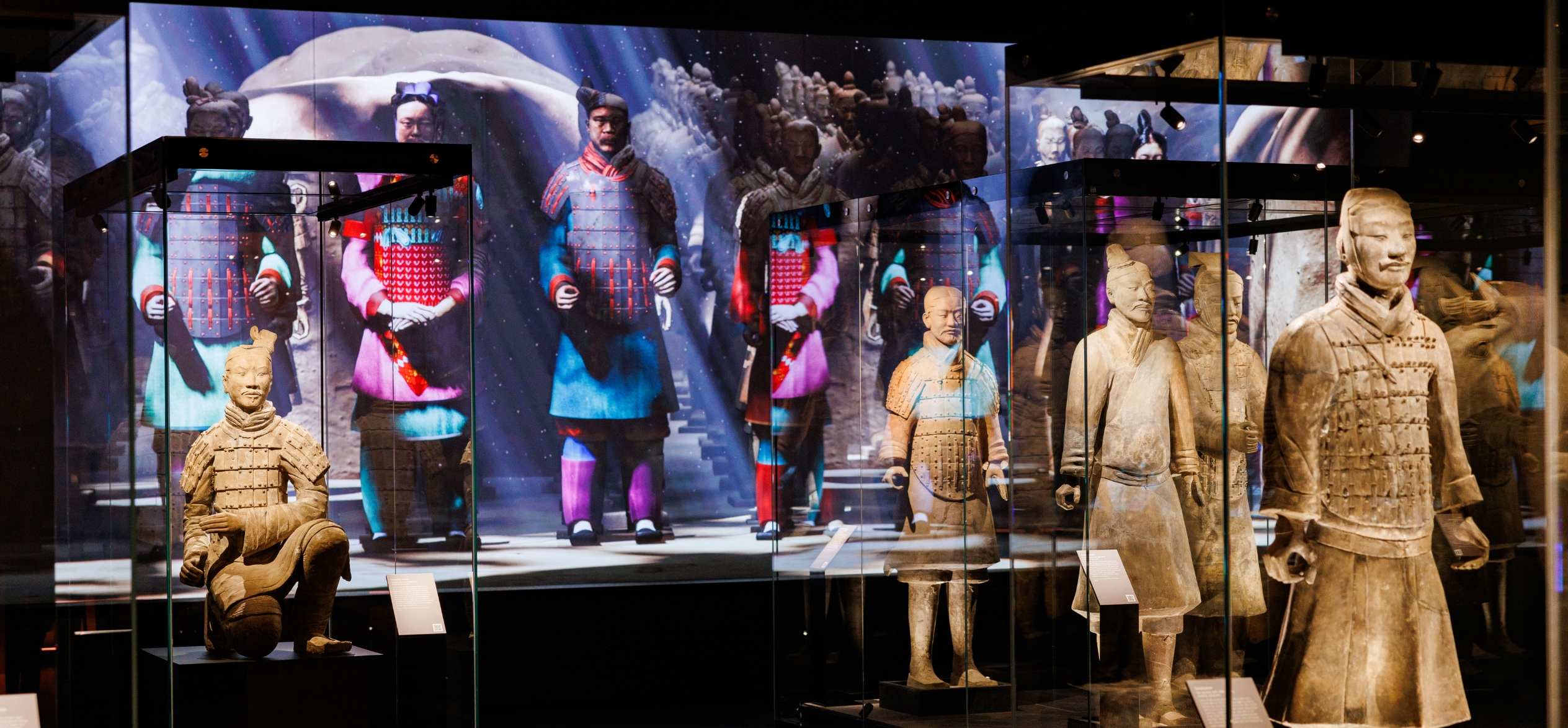
When in 1891, visitors stepped into a new museum featuring a collection of rocks, minerals, and fossils housed in a former prison in Perth, they could never have imagined that, 135 years later, in a world-class, contemporary building in the heart of the Perth’s cultural district, the WA Museum Boola Bardip would stage a show of ancient artifacts from China that would welcome more than 200,000 visitors, Terracotta Warriors: Legacy of the First Emperor. The exhibits take visitors back in time and, with digital installations, allow them to immerse themselves in this ancient civilization.
For a museum named Boola Bardip—“many stories” in Nyoongar, a local Aboriginal language of Western Australia—the exhibits reflect its commitment to sharing diverse narratives and promoting cultural understanding.
“The exhibition features stunning objects which tell the extraordinary story of China’s first Emperor, Qin Shi Huang, the dramatic impact of his short reign, and the periods immediately before and after,” says Alec Coles, the museum’s CEO.
A Mission to Inspire Curiosity
With seven public locations across Western Australia and a collection exceeding eight million objects, the WA Museum is the state’s leading scientific and cultural institution, sharing Western Australia’s natural and cultural heritage and stories of its people and biodiversity globally.
Exhibitions remain at the heart of the museum’s work, ranging from dinosaurs and Egyptian mummies to Kylie Minogue costumes—and, in 2025, the Terracotta Warriors, its most ambitious international exhibition yet.
With a mission to inspire curiosity to explore the past, question the present, and shape the future, it also offers professional learning opportunities for educators through in-person workshops and virtual formats. Through interactive online labs, it connects students across the state with museum experts.
Bringing Ancient China’s Legacy to Global Audiences
Running through February 2026 and attracting more than 300,000 visitors from across Australia and overseas, the world-exclusive Terracotta Warriors exhibition brings to life the extraordinary legacy created by China’s first emperor, Qin Shihuang.
The story of the terracotta warriors—life-size figures, each with unique facial features—has captivated the world since 1974, when it was discovered by chance in Xi’an, the capital of Shaanxi Province in central China, after lying below ground for more than 2,000 years. It was one of humanity’s most remarkable archaeological discoveries—an entire underground world created for the afterlife of an emperor.
Commissioned by China’s first emperor to protect himself in the afterlife, the warriors were buried in the emperor’s tomb, along with rare artifacts, many of which are in the WA Museum’s exhibition, including a lifelike bronze swan and the huge Bo Bell, which belonged to one of Qin Shihuang’s ancestors and was used in ceremonies.
Featuring more than 225 priceless treasures, many never before seen outside China, the exhibition reveals the brilliance of ancient China—its cultural and scientific achievements, its powerful dynasties, its ambition and artistry, and an empire that changed history forever.
The story of this empire unfolds across seven immersive galleries. Each section guides visitors through the life, legacy, and afterlife of Emperor Qin Shihuang, from scenes of daily life to the monumental tomb built to secure his eternal rule.
International collaboration is critical to our role as a scientific and cultural institution. This exhibition is a great example of how working together can create something extraordinary and promote mutual understanding between peoples.
Cultural Diplomacy Pays Dividends
The Terracotta Warriors exhibition is the result of a ground-breaking international collaboration between the WA Museum and China’s Shaanxi Provincial Bureau of Cultural Heritage, the Shaanxi Provincial Cultural Heritage Promotion Centre, and the Emperor Qin Shihuang’s Mausoleum Site Museum.
For ten years, the WA Museum worked to develop relationships with Chinese partners and cultural institutions as part of its efforts to build China-Australia cultural exchange. “The opportunity to create an exhibition centered around the Terracotta Warriors arose from these relationship-building conversations,” says Coles. ”The result is not only a unique and spectacular exhibition, but enriched cultural and diplomatic ties.”
Securing commitments for the loan of the ancient and priceless artifacts meant developing the trust needed to reassure 11 museums in China that their artifacts would be cared for properly and treated with respect.
Support from US philanthropists can help to unlock international collaborations, increase the museum’s visibility, and expand conservation outcomes in a region of immense scientific and cultural importance.
The show has been by far the museum’s most successful ever. “Not only do you get to see the warriors up close, which is very rare,” says Coles. “But you can see some 220 additional objects, about half of which have never been seen outside China. This is a unique exhibition in every sense.”
Building Global Support for the Future
Maintaining a world-class institution like the WA Museum requires substantial funding. This support enables high-profile collaborations, groundbreaking research, dynamic exhibitions, and diverse cultural exchanges.
A separate, registered not-for-profit, the Foundation for the WA Museum has three funds—The Discovery Endowment Fund, Marine Sustainability Fund, and the International Exhibitions Fund— which receive support from corporate partners, charitable foundations, and private donors, including through bequests. Funding comes in at many levels. Annual donors join the Foundation’s Patron Program, while other donors give gifts that range from $500 to more than $100,000.
Now it is expanding its fundraising efforts and building a global community of donors and advocates through a partnership with Myriad USA, where it has opened an American Friends Fund to enable tax-deductible gifts from supporters in the U.S.
“The Foundation for the WA Museum can now easily connect with like-minded U.S.-based philanthropists and receive contributions to the foundation for the WA Museum,” explains Coralie Bishop, Foundation CEO. By putting the institution “on the global radar,” she says, it will help it to compete internationally for exhibitions, research fellows, and cultural exchange while opening the door to more cross-border collaborations. “It has sparked many conversations about other opportunities for similar exhibitions,” says Bishop.
“For many people this is a rare chance to engage with the ancient heritage of a civilization very different from their own, encouraging empathy, learning, and global awareness.” Bishop believes that, through exhibitions like this, museums can play a key role in promoting understanding of communities and cultures around the world.